
Co-Kultur
Gemeinsame Anzucht: Welche Möglichkeiten gibt es nach mehreren IVF-Fehlschlägen?
Das Copenhagen Fertility Center bietet jetzt eine Kombination aus einer Vorbereitung der Gebärmutterschleimhaut sowie einer gemeinsamen, gleichzeitigen Anzucht von einer Epithelzelle der Gebärmutterschleimhaut und dem Embryo der Frau an.
Es konnte über mehrere Jahre hinweg beobachtet werden, dass eine geeignete Vorbereitung der Gebärmutterschleimhaut im Rahmen eines IVF-Zyklus die Schwangerschaftsrate bei älteren Frauen sowie Frauen, bei denen die Einnistung mehrfach fehlgeschlagen ist, verbessern konnte. Diese Vorbereitung wurde mithilfe einer Biopsie im Rahmen des Zyklus vor dem IVF-Behandlungszyklus vorgenommen.
Die Vorbereitung erfolgte im vorhergehenden Zyklus, um den Behandlungszyklus nicht zu stören. Andere Studien weisen jedoch darauf hin, dass es vorteilhaft sein kann, die Vorbereitung im gleichen Zyklus wie die Embryonenübertragung vorzunehmen. Es wurden hierbei keine Beeinträchtigungen bei der späteren Einnistung beobachtet und es wurde ebenfalls ein Anstieg der Schwangerschaftsrate verzeichnet.
Der Vorbereitungsvorgang dient dazu, Wachstumsfaktoren im Gewebe der Gebärmutterschleimhaut zu fördern und somit die Einnistung zu unterstützen.
Die Einnistung kann alternativ auch dadurch gefördert werden, dass die Interaktion zwischen Gebärmutterschleimhaut und Embryo imitiert wird, die bekanntermaßen bei einer In-vitro-Fertilisation entscheidend für eine optimale Einnistung ist. Dies geschieht durch die gemeinsame Anzucht einer Epithelzelle der Gebärmutterschleimhaut mit dem Embryo aus dem IVF-Vorgang. Bislang war dies in einem klinischen Umfeld schwer zu realisieren, da entweder Gebärmutterschleimhautzellen aus dem Ausland verwendet wurden (was gemäß der EU-Geweberichtlinie nicht zulässig ist) oder Zellen aus eingefrorenen Biopsien der Gebärmutterschleimhaut aus früheren Zyklen bei der gleichen Frau. Diese Zellen befinden sich nach dem Auftauen nicht immer in optimalem Zustand.
Das Copenhagen Fertility Center hat deshalb ein völlig neues Konzept für die Vorbereitung und gemeinsame Anzucht im gleichen Behandlungszyklus erstellt und konnte damit erfolgreich die Schwangerschaftsrate in schwierigen IVF-Fällen nach mehreren fehlgeschlagenen Einnistungsversuchen erhöhen.
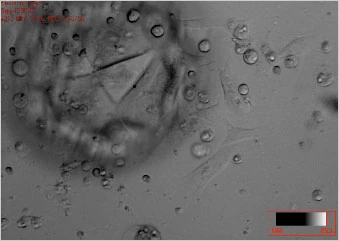
Gemeinsame Anzucht einer menschlichen Blastocyste und einer Gebärmutterschleimhautzelle in vitro. Bitte beachten Sie die hohe Anzahl von Bläschen zur Kommunikation zwischen dem Embryo und der einschichtigen Gebärmutterschleimhaut.
References
Lindenberg S, Hyttel P, Sjogren A. A comparative study of attachment of human, bovine, and mouse blastocysts to uterine epithelial monolayer. Hum Reprod 1989; 4:446-456. Embryologic outcome and secretome profile of implanted blastocysts obtained after coculture in human endometrial epithelial cells versus the sequential system Francisco Dominguez, Blanca Gadea, Amparo Mercader, Francisco J. Esteban, Antonio Pellicer, Carlos Simón
Fertility and sterility 1 February 2010 (volume 93 issue 3 Pages 774-782.e1 DOI: 10.1016/j.fertnstert.2008.10.019)
Beneficial effect of autologous endometrial cell coculture in patients with repeated implantation failure Victoria Eyheremendy, Fernanda G.E. Raffo, Mercedes Papayannis, Julia Barnes, Cintia Granados, Jorge Blaquier
Fertility and sterility 1 February 2010 (volume 93 issue 3 Pages 769-773 DOI: 10.1016/j.fertnstert.2008.10.060)
Bongso A, Ng SC, Fong C-Y, Ratman S. Co cultures: a lead in embryo quality improvement for assisted reproduction. Fertil Steril. 1991;67:120–122 Barmat LI, Liu HC, Spandorfer SD, Veek l, Damario M, Rosenwaks Z. Human preembryo development on autologous endometrial coculture versus conventional medium. Fertil Steril. 1998;70:1109–1113 Menezo Y, Hazout A, Dumont M, Herbaut A, Nicollet B. Coculture of embryos on Vero cells and transfer of blastocysts in human. Hum Reprod. 1992;7(Suppl 1):101–106 Jayot S, Parneix I, Verdaguer S. Coculture of embryos on homologous endometrial cells in patient with repeated failures of implantation. Fertil Steril. 1995;63:109–114 Barmat LI, Liu HC, Spandorfer SD. Autologous endometrial co-culture in patients with repeated failures of implantation after in vitro fertilization-embryo transfer. J Assist Reprod Genet. 1999;16:121–127 Rubio C, Simon C, Mercader A. Clinical experience employing co-culture of human embryos with autologous human endometrial epithelial cells. Hum Reprod. 2000;15(Suppl 6):31–38 Mercader A, Garcia-Velazco J, Escudero E, Remohi J, Pellicer A, Simon C. Clinical experience and perinatal outcome of blastocyst transfer after coculture of human embryos with human endometrial epithelial cells. Fertil Steril. 2003;80:1162–1168 Spandorfer SD, Pascal P, Parks J, Clark R, Veeck L, Davis OK, et al. Autologous endometrial co-culture in patients with IVF failures: outcome of the first 1030 cases. J Reprod Med. 2004;49:463–467 Spandorfer S, Park J, Davis O, Clarke R, Rosenwaks Z. A case controlled study evaluating autologous endometrial coculture (AECC) as an effective tool for young patients (age under 36 years) with multiple failed IVF attempts and diminished ovarian reserve. Fertil Steril. 2007;88(Suppl 1):O-275 Barash A, Dekel N, Fieldust S, Segal Ll, Schechtman E, Garanot I. Local injury to the endometrium doubles the incidence of successful pregnancies in patient undergoing in vitro fertilization. Fertil Steril. 2003;79:1317–1322 Menezo Y, Guerin J, Czyba J. Improvement of early human embryo development in vitro by coculture on monolayers of Vero cells. Biol Reprod. 1990;42:301–306 Nieto F, Watkins W, Lopata A, Baker G, Edgar D. The effect of coculture with autologous cryopreserved endometrial cells on human in vitro fertilization and early embryo morphology: a randomized study. J Assist Reprod Genet. 1996;13:386–389 Simon C, Pellicer A. Interleukin-1 system crosstalk between embryo and endometrium in implantation. Hum Reprod. 1995;10(Suppl 1):11 Spandorfer SD, Barnat LI, Liu HC, Mele C, Veeck L, Rosenwaks Z. Granulocyte macrophage stimulating factor production by autologous endometrial co-culture is associated with outcome for IVF patient with a history of multiple implantation failures. Am J Reprod Immunol. 1998;40:377–381 Spandorfer SD, Neuer A, Liu HC, Bivis L, Clarke R, Veeck L, et al. Interleukin-1 levels in the supernatant of conditioned media of embryos grown in autologous endometrial co-culture: correlation with embryonic development and outcome for patient with a history of multiple implantation failures. Am J Reprod Immunol. 2000;42:6–11 Spandorfer SD, Navarro J, Levy D, Black AQR, Liu HC, Veeck L, et al. Autologous endometrial co-culture in patient with IVF failures: correlation of outcome with leukemia inhibiting factor (LIF) production. Am J Reprod Immunol. 2001;46:375–380 Bendikson K, Park J, Rosenwaks Z, Spandorfer S. Do cytokine levels in the supernatant from conditioned media of embryos grown in autologous endometrial coculture correlate with pregnancy outcomes after in vitro fertilization?. Fertil Steril. 2007;(Supp 1):88;O-152 Barmat LI, Liu HC, Spandorfer SD, Veek L, Damario M, Rosenwaks Z. Importance of the biopsy date in autologous endometrial cocultures for patients with multiple implantation failures. Fertil Steril. 2002;77:1209–1213Arnold JT, Kaufman DG, Seppala M, Lessey BA. Endometrial stromal cells regulate epithelial cell growth in vitro: a new co-culture model. Hum Reprod. 2001;16:836–845 Simon C, Mercader A, Garcia-Velasco J, Nikas G, Moreno C, Remohi J, et al. Coculture of human embryos with autologous human endometrial epithelial cells in patients with implantation failure. J Clin Endocrinol Metab. 1999;84:2638–2646 Mercader A, Garcia-Velasco JA, Escudero E, Remohi J, Pellicer A, Simon C. Clinical experience and perinatal outcome of blastocyst transfer after coculture of human embryos with human endometrial epithelial cells: a 5-year follow-up study. Fertil Steril. 2003;80:1162–1168 Simón C, Gimeno MJ, Mercader A, O'Connor JE, Remohí J, Polan ML, et al. Embryonic regulation of integrins beta 3, alpha 4, and alpha 1 in human endometrial epithelial cells in vitro. J Clin Endocrinol Metab. 1997;82:2607–2616 Simón C, Mercader A, Garcia-Velasco J, Nikas G, Moreno C, Remohí J, et al. Coculture of human embryos with autologous human endometrial epithelial cells in patients with implantation failure. J Clin Endocrinol Metab. 1999;84:2638–2646